| |||

Showing posts with label unschooling. Show all posts
Showing posts with label unschooling. Show all posts
Monday, August 22, 2016
{radical art of homeschooling} it's a lifestyle


Sunday, August 21, 2016
{radical art of homeschooling} welcome

Welcome to The Radical Art of Homeschooling!
I have had this lab brewing for awhile and decided to offer it last summer as a sort of a beta lab, especially for those who are on the fence about sending their kids to school this. I think it will also be useful for those of us who are moving into new stages in our homeschool experiences. My kids are 10, 12, and 14. Their needs are rapidly changing and if I thought I had it all figured out when they were younger, I was wrong! I am constantly recalibrating to meet their evolving needs.
This lab will consist of weekday blog updates exploring different aspects of homeschooling. Topics will include: lifestyle, learning spaces, learning communities, uncommon resources, the value of process, building lessons, documentation, mission statements and parent care. I will include journal questions that you can write responses to or use as discussion prompts with anyone else who will be involved in homeschooling your children. We will not go into depth about learning styles or curriculum, although those topics would certainly be perfect to discuss in the Facebook group.
Which brings me to the second part of the lab. The community I am hoping we build through this lab will be as valuable an asset as anything I could ever offer. Please, participate in the FB discussions (join HERE). Share your experiences, fears, ideas, and breakthroughs. We have a gathered an amazing group of women who have varied backgrounds and rich experiences. We have seasoned homeschoolers, unschoolers, education specialists, new homeschoolers and part time homeschoolers.
Collectively, we are an amazing resource. So tap into it and share your expertise and divergent ideas. Never underestimate the value on a good online group! In the past few years, I have made friends online that have become real life friends. I hope to extend this to my children, too. After the lab, we can do nature and mail exchanges, send each other postcards or even meet up when we travel. We can build something spectacular!
You really do not need any supplies for this lab other than a journal, pen and internet access.
I will see you tomorrow! Here we go! (below is one of my favorite music videos speaking to the magic of spending your days with your kids- enjoy)
And as always, please let me know if you have any questions or issues. I am here for you.
onward,
Amy
This lab will consist of weekday blog updates exploring different aspects of homeschooling. Topics will include: lifestyle, learning spaces, learning communities, uncommon resources, the value of process, building lessons, documentation, mission statements and parent care. I will include journal questions that you can write responses to or use as discussion prompts with anyone else who will be involved in homeschooling your children. We will not go into depth about learning styles or curriculum, although those topics would certainly be perfect to discuss in the Facebook group.
Which brings me to the second part of the lab. The community I am hoping we build through this lab will be as valuable an asset as anything I could ever offer. Please, participate in the FB discussions (join HERE). Share your experiences, fears, ideas, and breakthroughs. We have a gathered an amazing group of women who have varied backgrounds and rich experiences. We have seasoned homeschoolers, unschoolers, education specialists, new homeschoolers and part time homeschoolers.
Collectively, we are an amazing resource. So tap into it and share your expertise and divergent ideas. Never underestimate the value on a good online group! In the past few years, I have made friends online that have become real life friends. I hope to extend this to my children, too. After the lab, we can do nature and mail exchanges, send each other postcards or even meet up when we travel. We can build something spectacular!
You really do not need any supplies for this lab other than a journal, pen and internet access.
I will see you tomorrow! Here we go! (below is one of my favorite music videos speaking to the magic of spending your days with your kids- enjoy)
And as always, please let me know if you have any questions or issues. I am here for you.
onward,
Amy

Wednesday, January 15, 2014
{how to} dip net

What you need :
~ nets (we have a selection that we have picked up at garage sales, pet stores and chain stores).
~ tubs (maybe some dishpans from the dollar store or other wide tubs)
~ camera
~ field guide (search online for printouts of the invertebrates in your area)
~ journal
Dip netting is such a great way to see what is living in the bodies of water around you. I am always surprised at what shows up in the net. From leaches to huge blue crabs there is so much more to the world that what we easily see. It is a little like magic, if you ask me.
We have dip netted in retention ponds, lakes, swamps and the ocean. It is one of our favorite things to do and something I hope to do much more of this year.
Here are some tips and guidelines, but I think you will see it is easy and intriguing once you get started.
(Obviously, be safe - whatever that means to the particular body of water you are exploring).
Start by fill in a tub or two with the water from the source you will be dip netting from.
Use your nets to gently scoop from the bottom of the water.
Take your net to one of the tubs and empty your scoop. Look around, be careful and see what it in there. We have separated out the animals into a separate tub to observe them while dip netting.
The best place to find creatures is at the edges, near vegetation and grasses and I would assume near rocks although we have very few of those in Florida.
Always treat the creature with gentle hands and return them to their home shortly after logging and observing them. It is essential that kids are taught to treat these specimens with respect. Do not remove them from their natural habitat.
A list or chart of the diversity you find turns this into a handy little science project, but really the exposure to these underground worlds is illuminating and inspiring to the dip netter.
Have you dip netted?
What is the most interesting thing you have brought up?
Wednesday, January 8, 2014
{life lab} the chore wheel


Tuesday, July 2, 2013
in which we pickled a shark

One of the only things I really missed about Florida while in France was beach evenings. Right now, the water in the gulf is hotter than a bathtub. The gentle, sloppy waves combined with the company of dolphins and sting rays makes it other worldly. We all float around in the soup until the last possible moment.
Then we beach comb. On this sojourn, we found a baby shark that had recently died (it had a small puncture wound on its head - maybe a bird?). It was too perfect a specimen to leave, so we did what we do. A little iPhone research and call for help on social media helped us decided that we would try to preserve the shark in isopropyl alcohol. (We need to have formalin on hand in the future!).
At 10 pm we pulled back into our center-of-the-state town and I flip flopped my sandy self into a Walgreens, loaded up my cart with alcohol and then asked the pharmacist for a syringe. "Any size will do," I casually said. "As long as I can use it to inject."

When we got home, we emptied and cleaned out our gallon popcorn jar and filled it up. We looked at the shark some more and then each kid took turns giving it shots. We were fascinated and saddened at the same time. But we thanked the shark for his life and hope he will live in our cabinet of curiosities for a long time.

And of course this sparked all sorts of conversations. Most interesting was the Jersey Shore shark attacks of 1916; what an amazing story!
Monday, April 15, 2013
the biggest memories are of the smallest things
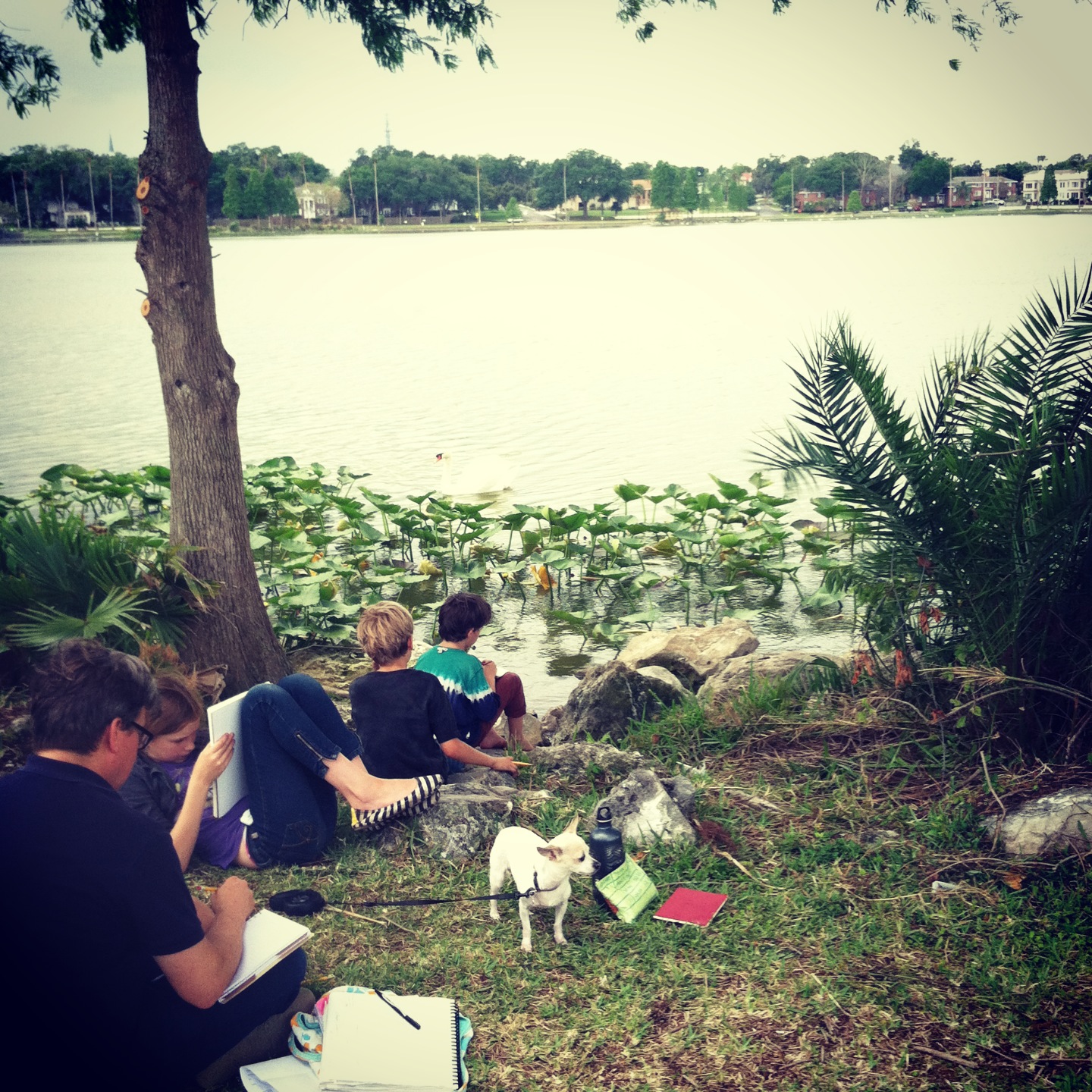
We are getting ready for a big trip, a monumental trip, a trip that can quickly get mangled up with all sorts of expectations. It will be wonderful and I am grateful.
Yet,
I am constantly reminded that most of our very biggest and most cherished memories are of the mundane. Everyday activities that are just a little bit more magic because of a turn in attitude and fun (and that turn is often elusive for my addled mind).
And they are nearly always free.
The other afternoon, we took our journals down to the local lake to draw and write and mediate. The weather was warm and windy, as balmy as Miami, a real feast for our senses.
A few drops began to fall, so we reluctantly gathered up our supplies and started walking the half mile home.
Then the heavens opened. As the sky was pouring rain and my kids' hearts were releasing joy. They love nothing more than to get caught in the rain. The brisk walk home was filled with constant chatter and stealing away into strangers' carports and eaves to catch our breath.
When we reached our home, they could not bear to stop, so they danced in the rain for the next 20 minutes, while my youngest sang at the top of his lungs. Whenever he is happy, he sings Star Wars and Christmas music mash ups.
I realized or remembered for the millionth time, to slow down, allow for the unexpected and embrace that which is, not lament that which is absent.
My mantra for the past year has been "all in." And I fall short from this tiny missive daily.
Yet,
everytime I fully experience the space we are in completely, with all my senses - reality is refocused into a surreal realm, where dreams and possibilities peak out with a shy little wave to let themselves be known.
All children need this more. A big part of this blog's mission is to capture and record and remind myself how it works for us.
And, I love to hear how it happens in your world too. Together, we can change the world - one tiny magical moment at a time.


Monday, February 25, 2013
{monday mission} start a collection

Building a collection is such a great activity to work on individually and as a family. We have enjoyed working on various collections over the years and have learned so much as they often spur new directions in our explorations. Here are a three ideas that have helped us in our collection of collections.

my tiniest collection - 3 woodpecker feathers
we currently have collections of:
bottle caps
smashed pennies from our travels
rocks
fossils
seed pods
my little pony figurines
restaurant crayons (?)
stamps
golden books
dolls and doll clothes
coins
sugar cubes from around the world
records
buttons
feathers


my feather collection is stuck in one of my found birds nests
2. Offer ways of both storage and display.
A collection can easily become a junk pile if it does not have a useful way to be both stored and displayed. We often keep our collections in tin and cigar boxes, plastic bins, shoe boxes, entire drawers and tote bags.
For display, think creatively. I like a series of glass fish bowls, a hanging banner or even a temporary table surface. Old letter press trays can be found at antique store rather cheap. Shadow boxes from the craft store can be painted or stained in any creative way.
Ask your kids to make a museum or dinner centerpiece with their collection. And invite people to come over and share their collections or just enjoy yours. It is fun to bring things out of storage to enjoy.

some collections are temporary
3. Allow collections to have a life cycle.
It is important to let kids take charge of their collections on their own. There is no easier way to kill a kid's interest and passion than by trying to take control of the project by demanding limiting perimeters or even by being overly enthusiastic.
When we took our daughter, a budding philatelist, to a local stamp shop to meet the owner, it was nearly soul crushing. Instead of encouraging her novice enthusiam, he immediately started explaining how she needed to focus her collection on only one country and should invest in a particular $100 album. There was no room for her interest or discovery. Thankfully, we all agreed his restrictions were unreasonable for the type of stamp collecting she was interested in.

4. Take the time to look at other collections.
We have enjoyed collections of citrus labels, Coca Cola memorabilia, gems and rocks, cigar bands, local shells, pins, marbles, doll furniture, historic costumes, old cars and more.
It is always invigorating to be around enthusiasts and learn what intrigues them about their area of speciality and passion. Because, in the end, we are not only learning about a new subject matter, we are also learning about how to craft an engaged and curiosity driven life.
In the comments, share with us about your collections...
Want to work with me in boosting your family's creativity?
check out the newest section of the Mama Scout Family e-Lab.
Monday, January 21, 2013
homeschooling is....

homeschooling is....
forays and explorations into canned fish products and picnics at the sidewalk on the go cart you built yourself.
(I would love to hear the weird things that your unschooly, autodidactic lifestyle has brought to you - please share in the comments).
Thursday, January 17, 2013
string painting with olders


sometimes i forget about simple, open ended art projects that we did when the kids were younger.
i might think, oh, we already did that. but that is the beauty of open ended projects - they can be done many times with different results.
we looked at patterns, and variables, and talked about string theory and worm holes and star births.
what art invitations would you like to revisit?
Friday, January 11, 2013
best toy ever :: an old mattress


Best toy ever.
An old mattress.
Used for jumping, napping, cuddling chickens and reading comics.
Soon, it will be dissected to peer into its mysterious innards.
Finally, spring jumping shoes are on the design board.
Thursday, December 27, 2012
choose your 2013 guiding word

Each year, I eschew resolutions or life lists and instead gather my intentions around one word. I let this word being my guiding principle and use it to motivate and re-center myself through out the year.
I recently read an interview with Joy Harjo where she said, " ...writing tells the truth, but also constructs a truth upon which to build on." YES! Writing, even for the non-writer, can not only help figure out where you are at, but can construct the road map for where you want to go.
There are so many possible truths and one way to get to the one you want is to write it (or paint it, sing it, perform it...)
Grab your journal and use any of the following prompts to uncover what your word for 2013 might be. And please, share with us!
What do I want to create in the new year?
What do I want to do and how do I want to spend my days?
What do I need to moving towards?
How do I want to feel each day?
What is the legacy I am creating right now?
What are the thoughts I am most afraid to think?
What idea makes my heart beat a little faster?
What can I give up?
How do I want to experience time?
What do I want to create in the new year?
My word for the year is fly - which for me means to take leaps of faith and do all the madcap things I am thinking/writing/plotting about. I started last year with my labs and was rewarded in both huge and subtle ways. This year, the ideas might be even bigger and I am going to jump into to clear, blue air without a safety net. So, be prepared for some spectacular claims and perhaps some crushing failures. I expect both.
________________________________________
Want to work with me and creative moms from around the world? Sign up for the Mama Scout Family e-Lab!
It starts January 7th and offers you 30 packed days of ideas, prompts and creativity projects to help your family reconnect and think outside the box. Troop 4 needs you and your energy!
Sunday, December 9, 2012
mail and children :: ideas and resources

In fact, my daughter even went as a ballerina-mail lady one Halloween, because ballerinas and postal workers were the two coolest jobs she could think of.
We have been having some mail time fun around here recently, so I thought I would share some of the different ways we have had played with the mail over the years.
Reading and writing letters is particularly useful for reluctant writers, but more importantly, the open ended and imaginative qualities are spectacular. You can create any world or character with letters and maps. The possibilities are endless.
Here are 7 ways to have fun with the mail.
{add your own suggestions in the comments!}
1. Participate in a nature exchange
Nature exchanges can be amazingly fun. Basically, you pair with someone from a different geographical region and swap a box full of nature items from your area. Leaves, shells, seed pods, rocks and pressed flowers are among the most popular bits. You can also send a little note, a regional folk tale, photo of your family, and handmade treats.

I have done several of these and love them. You can sign up different places on line, but I have had the best luck organizing them one-on-one. You might send out a request to some of the Facebook groups you belong to or just email someone you "know" online to ask if they would be interested.

I am considering running one through Mama Scout this spring, so make sure you are signed up for my newsletter and Facebook page to get the information.
2. Put a mailbox in the house (and the yard)
One of the best things we ever did was install a real mailbox in our house (the photograph at the top of the page). It is positioned upstairs in the landing between all the bedrooms and receives mail year round. We have also had an outdoor one for children to leave messages to each other and the bigger outside world.
These are magic making. And so easy you can do it NOW.
And of course, be sure to use those mailboxes. I have had long conversations with my children through the mail. Something about writing the letters makes the communication different, more thoughtful and deeper.
3. Make your own address labels, stamps, supplies and more.
This is so easy and obvious, but you would be surprised at how custom stickers and stamps add to the excitement. I just buy Avery labels in different sizes and make each kid their own return labels with fun fonts and pictures. You can also make stickers that have warnings or funny sayings on them. And of course, just coloring and drawing on the labels and turning them into stickers and stamps is fun too.
We love making our envelopes from magazine pages. I use this template because it is little and cute.
4. See what you can mail
Can you mail a soda bottle? A hula hoop? A ball? A Flip Flop? Try and see! While you are at the post office asking and finagling, set up a tour for you and your friends. This classic field trip is always educational and interesting.
5. Start a stamp collection
Maybe it is only natural that our love of mail turned one kid into a budding philatelist. My daughter has a super cool collection handed down from her Great Grandfather. She is interested in the images and where the stamps are from instead of building a complete collection. She recently received this book and loves the creative ways it suggests collecting.
6. Sign up for Mariposa Forest letter service
There are all sorts of subscription services for kids (magazines, craft kits...) but this is by far my very favorite.

When you join, your child receives biweekly letters from the forest creatures of Mariposa Forest. The letters include a gorgeous photograph and maybe a even a map. My kids were instantly smitten when we first tried a few dispatches from the forest and begged to get it year round (which they will for Christmas).
This is one of the best gifts I can think of this year. It is imaginative, lasts all year and supports creative women (which is huge in my book!)
7. Get a copy of JRR Tolkien's book Letters From Father Christmas (immediately!).
I saw this recommended by Lori at Project-Based Homeschooling and fell in love as soon as it arrived.
For over 20 years, Tolkien wrote his children a yearly letter Father Christmas. They included delicate drawings, hand-painted stamps, and hilarious tales of all the mischief happening at the North Pole. There are characters and languages you might now have know were up there. I promise, you will love this book. It is pure magic and a testament of the power of letters between parents and children. It might even spark your own creative project with your children.
Monday, November 5, 2012
{idea} real creative family living

As soon as my children were born and I started really watching how they interacted with the world, I knew I could not force my limited ways of thinking upon them. From early on when they made toys from acorns and fluff, experimented with language and at times seemed to connect with an invisible world that I could not see, I wanted to offer them a home that encouraged free thought, possibilities and hands on experiences. Whether telling stories, making up songs, or going on day long wanderings, I want them to feel that they are creating their experiences, their education, and their life.
The ideal of this vision sounds so much more saccharine than the messy reality (and by messy, I do not mean the way people use the word now to mean kind of sexy. I really mean messy).

For us, the creative life is not a swirly, gentle lifestyle where we are all happily singing as we transition from task to task. It takes immense personal responsibility and dedication to truly create a life and resist what I call "default living".
Our family life is painfully beautiful and sublime at times. Sometimes we can even enter flow as a family while we create. But many other times we are sloppy with our intentions and become frustrated and so angry at each other, ourselves and our emerging talents. We fail spectacularly, we get it all wrong and sometimes we do not how to rebuild what we have broken. A creative family is not always a peaceful family. The sweat and tears that pour while we individually dig into the meat of life and the essence of who we are is worth bearing and offers a deeper sense of well-being than just the causal ease of everyone getting along. We realize that being uncomfortable often opens a space where things start to get interesting.
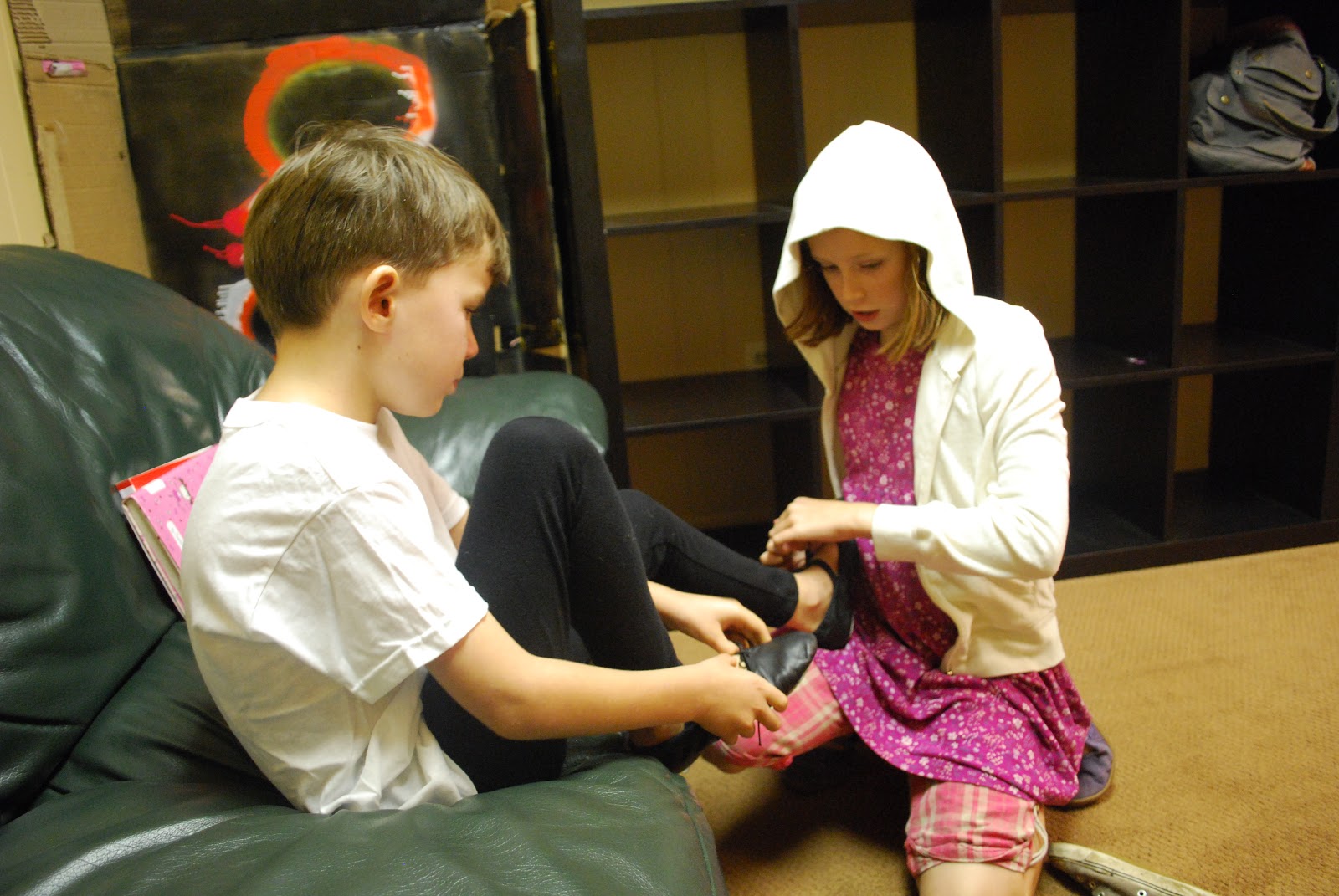
Allowing for and encouraging creativity makes the family culture so much richer. It offers our family a shared culture and language based on our experiences together. We have jokes and memories that are so specific they barely make sense to us. We become a team of dreamers, a club of doers and a battalion of warriors, all together.
From those first days, I could see that my kids had so much to offer me. They had new ways of looking at things, different methods of solving problems and more complex ways of experiencing life.
What would I have missed out on if I only supported my own myopic ideas on how a family should work?
I never would have tromped through a rainforest looking for stick bugs.
I never would have danced around in a roomful of strangers in my socks.
I never would have protested the circus or slept in my backyard.
What would I have missed out on if I only supported my own myopic ideas on how a family should work?
I never would have tromped through a rainforest looking for stick bugs.
I never would have danced around in a roomful of strangers in my socks.
I never would have protested the circus or slept in my backyard.
Encouraging creativity in your home is so much more than making sure you have markers and glue available to your children. And while I think a creative, "open-source" lifestyle looks different for each family, here are three fundamentals that I think we all share:
embracing a "yes" philosophy.
Automatic "no's" shut down the any conversation and connection we might build with the asker. Strive for a "yes" always, even if it needs qualifiers. And you can turn the responsibility over to the requester. "Yes, we can go to the Galapagos Islands, if we can figure out how to save $15,000. How can we do that?" (That is an actual conversation going on in my house now. When I was growing up, I hated the automatic "no" and the way it pushed me out of the process of problem solving).
teaching our kids how to look closely
By allowing ourselves to slow down, to avoid automatically heading to electronic devices when there is a lull in the day, and to experience boredom, we also encourage deeper looking and noticing. I think that being able to "look" closely and notice the minute is a skill that is not always valued in the shotgun approach to many of our day's activities. The subtle and small can become the infinite and profound, offering answers or at least some direction to the biggest problems facing us. I will always remember when my 8 year old son called me over to hear the sound of a snail eating or how we used to wait and watch our chickens lay their eggs. The mystery of the universe revealed itself and bound us together in new ways.
talking and reading a lot
When people ask me what curriculum we use, my answer for the longest time was, "The one where you talk all day." Through conversation; real, meaningful conversation, we as a family ask big questions, make proclamations about what we believe, change long held tenets, and begin to connect the threads from all the facets of our lives into a more cohesive structure. Reading out loud as a family encourages exploration, discovery and even more conversation.
Monday, October 29, 2012
{art lab} finding art in the street

We like to look. And spend a lot of time in the alley ways around our house hunting for things, recording textures, and even hanging poems on trees. When I ran across Carla Sonheim's tutorial on blob hunting, I knew what our next alley adventure would be (and that I had found a great new resource).

We headed out with our creativity journals and looked for shapes that were made from stains, cracks, leaves, shadow or anything that caught our fancy. This exercise required that everyone really look past the actual items they were seeing in the road to the primary shapes that were revealed.

I was happily surprised at how much we got into this. Despite the fact that we were just going to collect the shapes (and then go inside with art supplies) they stopped to draw what they saw immediately.
In fact, I was unable to participate as much as I had planned because I was ping-ponging back and forth as each kid wanted to show the magical scenes they were discovering under their feet.

This reminded of a water painting project we did a few weeks ago.
These sorts of things seem so simple, but are really a linchpin of our curriculum. By just learning to slow down and look, and then imagine, kids' worlds are rapidly expanded.
They begin to make new connections and see fresh possibilities in even the most mundane circumstances.

Schools will not teach your children to see maps in paint spills or dancing men in sidewalk cracks. As this is not a quantifiable skill, you will not see it on any worksheet - which is why it is so imperative for parents to provide this type of experience for their children as much as possible.

This is not about raising dreamers, it is about raising thinkers.
Thinkers and doers who will create technologies, write novels and plays, and discover scientific breakthroughs because they are able to look at disparate information in unique ways.


Tuesday, October 9, 2012
guerrilla art :: kind bombing with kids

My young writer's group met at the library recently. After we had shared our work and talked about satirical writing, I planned a final project of kind bombing.
I showed the kids this video and asked them what they thought of it. They all thought it was awesome and I proposed that we did something similar right then.
We wrote good wishes and thoughts on paper and hid them in books in the children's department.
Simple, positive, and a great way to get kids to love writing.
They responded to this project enthusiastically, coming back to make more messages several times. Each kid decided what section to "bomb" which was fun. Chapter books, insect books and sports books were hit the hardest.
The secretive nature and sneaking around for good seemed to inspire them as they talked about what people would think when they opened a book and a sweet note fell out.
The idea of creating a little something and leaving it and your trace in the world is powerful for kids (and adults). What seems simple and almost like a prank, actually connects kids to the public sphere and gives them a sense of agency within it.
They can actively shape their environment.


If you like this sort of out-there fun, click over and follow me on Facebook.
And be sure to check out my new Holiday Lab!
Subscribe to:
Posts (Atom)
LinkWithin
